IRS Form 8453-PE Instructions
If you’re filing a partnership tax return, you may see IRS Form 8453-PE, E-file Declaration for Form 1065.
This article will walk you through what you should know about this tax form, including:
- What is IRS Form 8453-PE
- How to complete this form and when you should file it
- How to obtain a copy of this tax form
Let’s start with discussing exactly what IRS Form 8453-PE is.
Contents
Table of contents
How do I complete IRS Form 8453-PE?
There are three parts to this one-page tax form, which we’ll go over, step by step:
- Part I: Form 1065 Information
- Part II: Declaration of Partner or Member or Partnership Representative
- Part III: Declaration of Electronic Return Originator (ERO) and Paid Preparer
However, let’s start at the very top of the form, in the taxpayer information fields above Part I.
Taxpayer information
In this section, you’ll enter basic information about the tax return.
Calendar year or fiscal year
If the trust or estate operates on a calendar year basis, leave this area blank.
If the trust or estate operates on a fiscal year basis, enter the beginning and ending months of the fiscal year.
Fiscal year
A fiscal year is any tax year consisting of 12 consecutive months that end on the final day of any month except December. For example, the federal government operates on a fiscal year that runs from October 1 to September 30 of the following year.
Name of Partnership
Enter the partnership’s name in this field.
Employer identification number
Enter the employer identification number (EIN) of the estate or trust in this field. An employer identification number is a 9-digit tax identification number for tax entities who are not individuals.
Part I: Form 1065 Information
In Part I, we’ll include certain items from your Form 1065, U.S. Return of Partnership Income.
Line 1: Gross receipts or sales less returns and allowances
In Line 1, enter the amount of gross receipts, or total sales after returns and allowances. You should find this figure on IRS Form 1065, Line 1c.
Line 2: Gross profit
From your partnership return, enter the gross profit figure, which should be on Line 3.
Line 3: Ordinary business income (loss)
From your Form 1065, enter the amount of ordinary business income, located on Line 23. If this is a loss, enter the amount in parentheses.
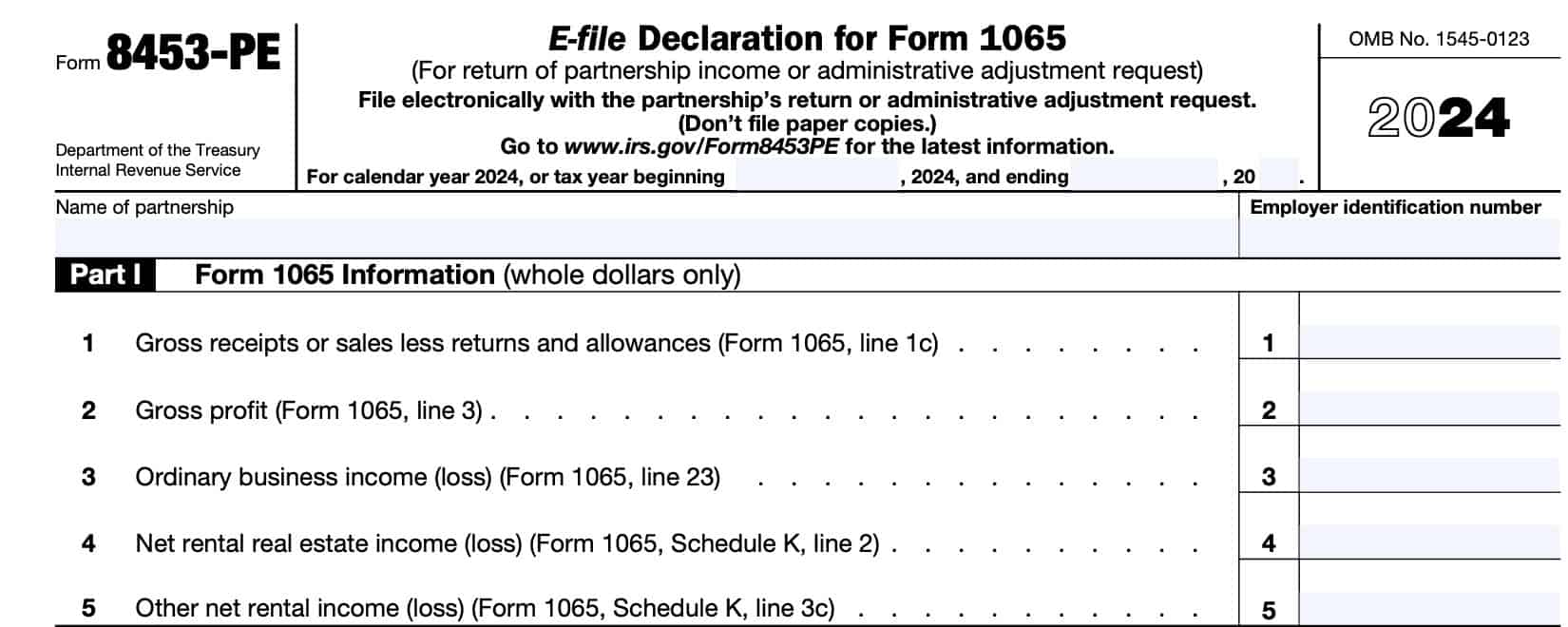
Line 4: Net rental real estate income (loss)
In Line 4, enter the net rental real estate income from Schedule K, Line 2. For losses, enter the amount in parentheses.
Line 5: Other net rental income (loss)
Enter any other net rental income from Schedule K, Line 3c.
Part II: Declaration of Partner or Member or Partnership Representative
In Part II, the partner, member, or partnership representative will sign and date the Form 8453-PE, and enter their title in the space provided.
In doing so, that person declares, under penalties of perjury, the following:
- He or she is either a partner or member of the partnership filing the tax return. If transmitted as part of an administrative adjustment request (AAR), then he or she attests to being the partnership representative.
- The information provided to the electronic return originator (ERO), transmitter, and/or intermediate service provider (ISP), and the amounts entered in Part I agree with the corresponding amounts on the associated partnership return
- The partnership’s return or AAR is true, correct, and complete
- He or she has given permission to transmit the return or AAR to the Internal Revenue Service
- The Internal Revenue Service has permission to communicate receipt of this return and accompanying forms and schedules
- The IRS has authorization to disclose the reason for any delay in processing
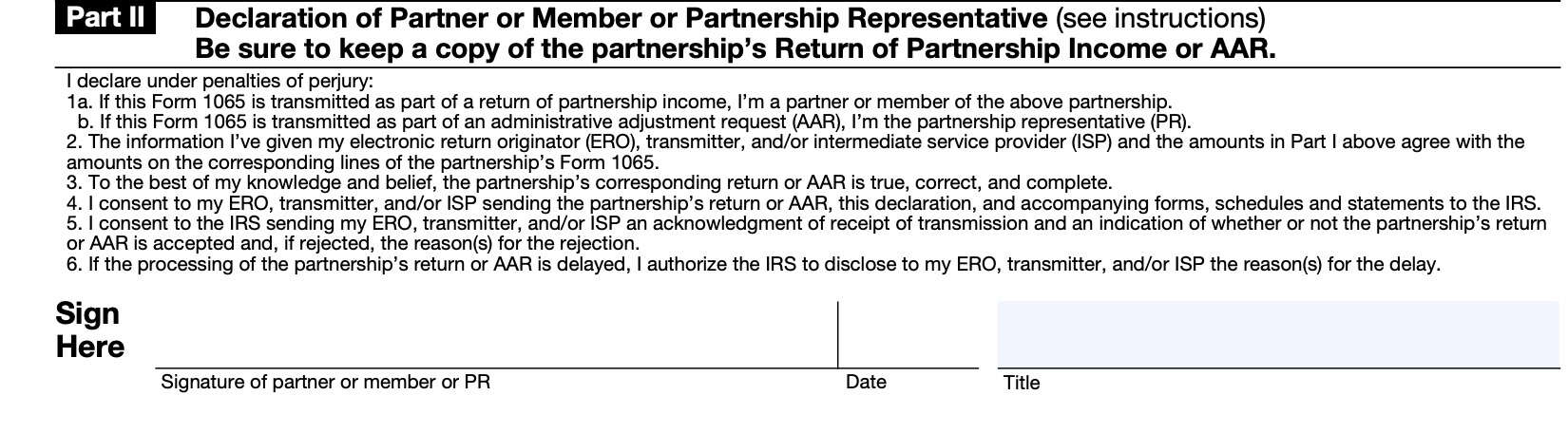
If the Form 1065 is being transmitted and filed as part of a partnership return, then the declaration must be signed by a partner or member.
If the Form 1065 is being transmitted and filed as part of a partnership AAR, then the declaration must be signed by the PR; or designated individual, if the partnership representative is an entity.
ERO changes to return
If the ERO makes changes to the electronic return or AAR after receiving a signed Form 8453-PE by the partner or member or PR, whether it was before it was transmitted or if the return or AAR was rejected after transmission, the ERO must have the partner or member or PR complete and sign a corrected Form 8453-PE if either:
- The total income (loss) on Form 1065, line 8, differs from the amount on the electronic return or AAR by more than $150; or
- The ordinary business income (loss) on Form 1065, line 23, differs from the amount on the electronic return or AAR by more than $100.
Part III: Declaration of Electronic Return Originator (ERO) and Paid Preparer
In Part III, the ERO and paid tax return preparer declare that the submitted information is complete and correct, under penalty of perjury.
Difference between the ERO and paid preparer
There is a difference between an electronic return originator (ERO) and a paid preparer.
Paid preparer
A paid tax return preparer is anyone who is paid to prepare the estate’s or trust’s tax return. A paid preparer must enter their preparer tax identification number (PTIN) in the paid preparer only portion of Part III.
To receive a PTIN, a paid preparer must complete and submit IRS Form W-12, IRS Paid Preparer Tax Identification Number Application and Renewal to the Internal Revenue Service.
Electronic return originator (ERO)
The ERO is one who deals directly with the fiduciary and either prepares tax returns or collects prepared tax returns, including Forms 8453-PE, for fiduciaries who wish to have the return of the estate or trust electronically filed. The ERO’s signature is required by the IRS.
However, the ERO is not responsible for reviewing the return. The ERO is only responsible for ensuring that the information on Form 8453-PE matches the information on the tax return itself. Additionally, the ERO will give the fiduciary a copy of all forms and information submitted to the IRS.
If also the paid preparer, then the ERO is responsible for reviewing the return. If there is a separate paid tax return preparer, he or she must sign below.
ERO’s use only:
In this section, the ERO will provide:
- Signature & date
- Check if also the paid preparer
- ERO does not need to complete the paid preparer use only section, below
- Check if self-employed
- Social Security number or preparer tax identification number (PTIN)
- Firm’s name or ERO’s name, if self-employed
- Employer identification number (EIN)
- Phone number

Paid preparer use only:
In this section, the paid preparer will provide:
- Name
- Signature & date
- Check if self-employed
- PTIN
- Firm’s name
- Firm’s EIN
- Address
- Phone number
Video walkthrough

Are you using the correct Form 8453?
According to the IRS website, there are 12 different versions of IRS Form 8453, including IRS Form 8453-PE. Below is a brief summary of each of the 11 other IRS forms, and what each form does.
IRS Form 8453, U.S. Individual Income Tax Transmittal for an IRS e-file Return
Taxpayers use IRS Form 8453 to send required paper forms or supporting documentation that cannot be submitted to the Internal Revenue Service via electronic means.
IRS Form 8453, U.S. Individual Income Tax Transmittal for an IRS e-file Return (Spanish)
Spanish version of the individual income tax transmittal tax form described above.
IRS Form 8453-CORP, U.S. Corporation Income Tax Declaration for an IRS e-file Return
U.S. corporations use IRS Form 8453-CORP to:
- Authenticate an electronic Form 1120, U.S. Corporation Income Tax Return
- Authorize the ERO, if any, to transmit via a third-party transmitter
- Authorize the ISP to transmit via a third-party transmitter if filing online (not using an ERO)
- Provide the corporation’s consent to directly deposit any refund into a bank account and/or authorize a direct debit for payment of federal taxes owed
IRS Form 8453-EG, E-file Declaration for Forms 709 and 709-NA
Taxpayers use IRS Form 8453-EG to:
- Authenticate the electronic versions of gift tax returns:
- Form 709, United States Gift (and Generation-Skipping Transfer) Tax Return
- Form 709-NA, United States Gift (and Generation-Skipping Transfer) Tax Return
- of Nonresident Not a Citizen of the United States
- Authorize the electronic filer to transmit via a third-party transmitter; and
- Authorize an electronic funds withdrawal for payment of federal taxes owed.
IRS Form 8453-EMP, Employment Tax Declaration for an IRS e-file Return
Taxpayers use Form 8453-EMP to:
- Authenticate an electronic Form 940, 940-PR, 941, 941-PR,
- 941-SS, 943, 943-PR, 944, or 945,
- Authorize the ERO, if any, to transmit via a third-party transmitter
- Authorize the intermediate service provider (ISP) to transmit via a third-party transmitter if filing online without using an ERO, and
- Provide taxpayer’s consent to authorize an electronic funds transfer for payment of federal taxes owed
IRS Form 8453-EX, Excise Tax Declaration for an IRS e-file Return
Taxpayers use IRS Form 8453-EX to:
- Authenticate electronic versions of the following forms:
- IRS Form 720
- IRS Form 2290
- IRS Form 8849
- Authorize the ERO, if any, to transmit via a third-party transmitter
- Authorize the ISP to transmit via a third-party transmitter if filing online without an ERO
- Provide taxpayer’s consent for electronic funds withdrawal to pay taxes owed
IRS Form 8453-FE, Estate/Trust Declaration for IRS e-file Return
Taxpayers use IRS Form 8453-FE to:
- Authenticate the electronic Form 1041, U.S. Income Tax Return for Estates and Trusts;
- Authorize the electronic filer to transmit via a third-party transmitter; and
- Authorize an electronic funds withdrawal for payment of federal taxes owed.
IRS Form 8453-R Declaration and Signature for Electronic Filing of Form 8963
Taxpayers use IRS Form 8453-R to authenticate the electronic filing of Form 8963, Report of Health Insurance Provider Information.
IRS Form 8453-S, U.S. S Corporation Income Tax Declaration for an IRS e-file Return
U.S. S-corporations use this tax form to:
- Authenticate an electronic Form 1120-S, U.S. Income Tax Return for an S-Corporation
- Authorize the ERO, if any, to transmit via a third-party transmitter
- Authorize the ISP to transmit via a third-party transmitter if filing online (not using an ERO)
- Provide the corporation’s consent to directly deposit any refund into a bank account and/or authorize a direct debit for payment of federal taxes owed
IRS Form 8453-TE, Tax Exempt Entity Declaration and Signature for Electronic Filing
Tax-exempt entities use this tax form to:
- Authenticate one of the following tax forms:
- IRS Form 990, Return of Organization Exempt From Income Tax
- IRS Form 990-EZ, Short Form Return of Organization Exempt From Income Tax
- IRS Form 990-PF, Return of Private Foundation
- IRS form 990-T, Exempt Organization Business Income Tax Return
- IRS Form 1120-POL, U.S. Income Tax Return for Certain Political Organizations
- IRS Form 4720, Return of Certain Taxes Under Chapters 41 and 42 of the Internal Revenue Code
- IRS Form 8868, Application for Automatic Extension of Time To File an Exempt Organization Return
- IRS form 5227, Split-Interest Trust Information Return
- IRS Form 5330, Return of Excise Taxes Related to Employee Benefit Plans, and
- IRS Form 8038-CP, Return for Credit Payments to Issuers of Qualified Bonds
- Authorize the ERO, if any, to transmit via a third-party transmitter
- Authorize the intermediate service provider (ISP) to transmit via a third-party transmitter if filing online without using an ERO
- Authorize an electronic funds withdrawal for payment of federal taxes owed as determined by one of the following:
- IRS Form 990-PF
- IRS Form 990-T
- IRS Form 1120-POL
- IRS Form 4720
- IRS Form 5330
- IRS Form 8868
IRS Form 8453-WH, Electronic Filing Declaration for Form 1042
Taxpayers use IRS Form 8453-WH to:
- Authenticate an electronic Form 1042, Annual Withholding Tax Return for U.S. Source Income of Foreign Persons;
- Provide consent to authorize an electronic funds withdrawal for payment of the balance due on IRS Form 1042
- Authorize the intermediate service provider (ISP) to transmit via a third-party transmitter if you are filing online (not using an ERO); and
- Authorize the ERO, if any, to transmit via a third-party transmitter
IRS Form 8453-X Political Organization Declaration for Electronic Filing of Notice of Section 527 Status
After electronically submitting IRS Form 8871, Political Organization Notice of Section 527 Status, an authorized official must sign, date, and send this form to the Internal Revenue Service. This allows the political organization to:
- File an amended or final Form 8871, or
- To electronically file Form 8872, Political Organization Report of Contributions and Expenditures.
Frequently asked questions
Taxpayers use IRS Form 8453-PE to accompany an electronically filed return for partnerships, when filed by an intermediate service provider (ISP) or electronic return originator (ERO). Taxpayers also use this form to authorize electronic funds transfer for tax payments or refunds.
IRS Form 8453-PE is used to submit an electronic tax-exempt tax return through an intermediate service provider (ISP) without using an electronic return originator (ERO). IRS Form 8879-PE allows the ERO to sign the return with an identity protection PIN number (IP PIN). An ERO may use either form.
Where can I find IRS Form 8453-PE?
You can find the latest versions of IRS forms on the IRS website. For your convenience, we’ve attached the latest version of IRS Form 8453-PE here, in this article, as an Adobe Acrobat PDF file.